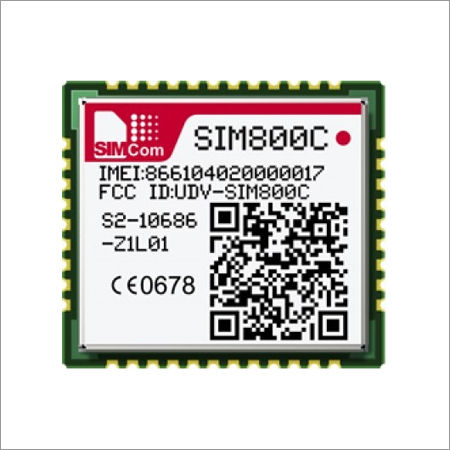
About SIM800C GSM GPRS Quad-band Module
Features:
- Communications module type:GSM/Bluetooth
- Standard :2G
- Module output power:1 W (class 1 @ 1800/1900MHz), 2W (class 4 @ GSM850/EGSM900)
Specifications for GPRS Data:
- GPRS class 12: max. 85.6 kbps (downlink/uplink)
- PBCCH support
- Coding schemes CS 1, 2, 3, 4
- PPP-stack
- USSD
Interface:
- 42SMTpins including
- Analog audio interface
- RTC backup
- USB interface
- Serial interface
- Interface to external SIM 3V/1.8V
- GPIO
- ADC
- GSM Antenna pad
Versatile Connectivity for Global NetworksEngineered for quad-band GSM/GPRS coverage, the SIM800C ensures worldwide compatibility, making it a solid choice for projects requiring reliable cellular communication on a global scale. With its robust protocol support and data transfer rates up to 85.6 kbps, it addresses the needs of IoT, automation, and telemetry applications seamlessly.
Compact Design with Powerful FeaturesDespite its small footprint-measuring just 17.6 x 15.7 x 2.3 mm-the SIM800C integrates comprehensive features including voice, SMS, fax, and data capabilities, multi-slot GPRS support, and multiple hardware interfaces. Its low idle and active current consumption supports battery-powered projects, while SMD mounting ensures effortless integration.
Efficient Integration and Easy UpgradesDesigned for embedded system developers, the SIM800C offers flexible UART, I2C, GPIO, ADC, and PWM interfaces. Firmware upgrades can be performed via its serial interface, ensuring your applications remain secure and up-to-date with minimal downtime.
FAQ's of SIM800C GSM GPRS Quad-band Module:
Q: How do I integrate the SIM800C module into my electronic device?
A: To integrate the SIM800C, solder it onto your main PCB using the SMD mounting pads. Connect the power supply (3.4V to 4.4V), SIM card (1.8V/3V), external antenna pad, and required signal interfaces such as UART or I2C. Reference the datasheet for specific pinouts to interface with your microcontroller or processor.
Q: What applications can benefit from using the SIM800C GSM GPRS module?
A: The module is well-suited for IoT devices, M2M communication, embedded systems, and any application requiring global GSM/GPRS connectivity, such as asset tracking, remote monitoring, smart meters, industrial automation, and wireless sensor networks.
Q: When should I use the external antenna interface on the SIM800C?
A: An external antenna should be used when optimal signal strength or remote placement is required, particularly in environments with weak network coverage or where the module's onboard antenna is insufficient. Connect an appropriate GSM antenna to the provided pad for improved performance.
Q: Where is the SIM card installed on the SIM800C module?
A: The SIM800C supports a SIM card interface accommodating 1.8V or 3V SIM cards. The SIM card is inserted into a compatible holder that connects to the provided SIM interface pins. Ensure correct orientation and compatibility for stable operation.
Q: What is the process for upgrading the SIM800C firmware?
A: Firmware upgrades are performed through the module's serial interface (UART). Use manufacturer-provided update tools and follow the step-by-step guide to load the new firmware, ensuring reliable updates without removing the module from your device.
Q: How does the SIM800C module help reduce power consumption in IoT projects?
A: The SIM800C consumes approximately 1.2 mA in sleep mode and about 350 mA during active operation. Its efficient power management is suitable for battery-powered or energy-sensitive IoT devices, helping extend operational life between charges or battery replacements.
Q: What benefits does quad-band support provide for connectivity?
A: Quad-band capability allows the SIM800C to operate globally by supporting major GSM frequencies (850, 900, 1800, 1900 MHz). This ensures consistent communication and device deployment in diverse geographic regions without hardware changes.

 Send Inquiry



 Send Inquiry

 Send Inquiry

